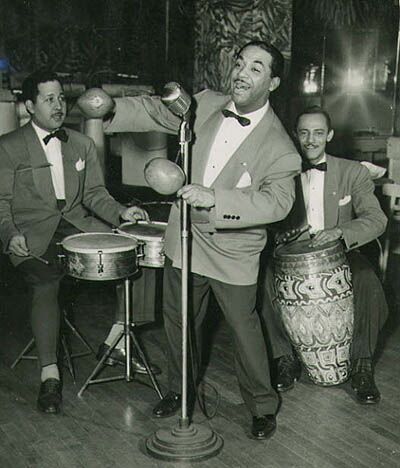
This is a brief meditation on ethnicity as a source of all powerful musical styles, as a kind of curse in the contemporary world of nation states, and as an ever more complex puzzle for every student of popular music to solve. Browsing through the Wilfrid Mellers classic, one can browse a long time before finding much on ethnicity or class as foundations for musicking. Music in a New Found Land simply extends the high culture worldview used in writing about Bach or Beethoven or Orpheus to generously include the best of popular music in a civilization that is ever broader but always universal. Mellers writes from on high, a heavenly perspective, in which sympathetic judgments of everything musical under the sun are dispensed with gusto and St. Peter is encouraged to let all kinds of quality pass the gates, or perhaps we should describe it as an Olympian-situated knowledge that savors the foibles and idiosyncrasies of all the music makers below because the gods and mortals share so many passions. I know I have enjoyed this recent browsing greatly because I share in almost all the judgments: the appreciation of Thelonius Monk’s fingerings, the disgust with Stan Kenton’s mechanization, the appraisal of Menotti’s emptiness, the disappointments of so many ‘third stream’ syntheses. Mellers gets it right in phrase after phrase, page after page, but almost always by listening intelligently from the top down.
A theoretical or interesting quotation from Mellers on ethnicity per se is hard to find. While he does not 'pronounce' on ethnicity, he does have a lot to say about musics which are often thought of as ethnic - and not only Africans-American and country but other 'primitive' or 'prime' musics of the world as well. The primacy or firstness or originality of these musics seems to be taken for granted as varieties of grist for a universal mill in which 'serious' music, perhaps, is the miller. A few years ago I would have been very offended by this. After all, 'ethnicity' has been an axiom in most of my work, phrased as nationalist perspective in Urban Blues (1992), combined with classlessness in Tiv Song (1979), with class in Polka Happiness (Keil et al., 1992), with class and caste in our work on Greek Macedonian Gypsy musicians (The Instruments with A. V. Keil, in progress). All along, and especially in My Music (Crafts et al., 1993) I have been working from an ethnographic, bottom-up or culture-constituting point of view - where does the music come from? or in My Music how does each person fit music into a life? - rather than from a critical or interpretive, 'here is how I hear it' perspective. At the moment , however, I am very sympathetic to the Mellers variety of intelligent listening to everything from aloft, and more than a little ambivalent about my own past prediction for snipping out identities, both ethnic and idiocultural, from the social fabric, in order to celebrate them.
Much of this ambivalence has grown out of our Gypsy research. Mulling over interviews with the most senior musicians of Iraklia's neighbourhood, it is clear that despite having been settled in this one town for well over a century, the oldest people can think of themselves as having had at least three ethnic identities in addition to being Roma or Gypsies. In the interviews these ethnic identities are presented as choices made or not made in the midst of historical crises. 'When the Turks left this town in 1922 during the exchange of populations we could have gone with the Turko-Gyftoi because we certainly spoke Turkish fluently.' 'When we were starving during World War II and the occupying Bulgarian forces asked us if we were Bulgarian we probably should have said yes because more of us would have lived and we certainly spoke Bulgarian fluently. I served for two years in a Bulgarian army band playing for the officers.' 'All of our people have been Greek for as long as anyone can remember.' 'We Rom really have no music or folklore of our own, our deepest music for our own weddings is really Turkish.' 'The people who love our music the most are "the pained peoples," the Pontic Greek refugees from around the Black Sea, the Vlachs (a Rumanian speaking minority), the Slavic speaking minority.' I have made up these sentences and I could either make up more or patiently extract from our interview transcripts dozens of similar examples of people testifying to the flexibility of 'ethnicity' in Greek Macedonia.
This may be an extreme case of multiple or overlapped identities, but I suspect that just about every person you or I meet in the street is less mono-ethnic and much more complicated musically, historically, culturally than we think. Who has four grandparents from one tribe any more? Who listens to fewer than a dozen styles music?
From a Gypsy point of view and also from a universal or xenographic perspective outside all specific cultures (assuming for a moment, incorrectly, that such a xenographic vantage point exists), the quite recently invented states, with brand new and variably fascistic definitions of ethnicity in hand, have forced people to join their 'bundle' with defined borders if they want to claim land and citizenship. What had been flexible, fluid, complex, mosaicised identities for both individuals and groups suddenly assume a fixed and layered look as the big lie of a mono-ethnic nation-state becomes naturalized. The Gypsies of northern Greece can choose at times of war, whether or not to be Greek, Bulgarian or Turkish (and may yet be offered these choices again) but they cannot choose to be Rom. Or put it this way, they have less chance of choosing a Rom identity than 20 million Kurds have of choosing a Kurdish identity. Over a hundreds other peoples united on their territories are struggling for states ahead of the scattered Gypsy populations. Only a planned and peaceful reduction of populations in world-governed loose federations might eventually have room for Rom qua Rom, both settled and roaming.
What does all this have to do with 'ethnic' music in the USA? Well, in the past all music has been coming from tribes or 'ethnic groups' until very recently (remember Phrygian, Dorian and Lydian describe how those tribes sang in the era before homer, and rap was strictly a Bronx street corner phenomenon fifteen years ago). In the future I have the deepest desire to restore Gaia's world of maximized cultural and species diversity. But at this historical moment, as the 'cleansing' continues unopposed in Bosnia and the Third World War (Nietschmann, 1987) continues inside dozens of other states, my original title for this essay presented a sequential analysis within the parentheses - '(Black music, country music, others all)' - that is both very logical and completely problematic. Logical because 'Black music' has become virtually all of American music as jazz suffused pop and rhythm and blues became rock; 'country' is the next biggest music in America; 'other' could include every thing from Latin or salsa to the six varieties of polka; and finally, one could argue, 'all' of our music is ethnic - as 'James' puts it My Music, 'everything you hear comes from some kind of ethnic background, and from somewhere. So why do you want to be narrow?' (Crafts et al., 1993, p. 180).
But from ethnographic perspectives 'ethnicity' is completely problematic, too. Black musicians and leaders usually do not want to be considered 'ethnic' because it lumps the black experience within all the other immigrant experiences as if everyone volunteered to come over here; glossing over the middle passage, slavery and racism is the last thing they want to do. Country musicians would probably scratch their heads in puzzlement over the 'ethnic' label since country is just plain old everyday American music; hell, Charlie Pride sounds like a good ol' boy, ain't nothin' ethnic about it, we're singin' the songs of the unsilent majority. Most of the 'others' - German-Americans, Italian-Americans, Polish-Americans, Slovenian-Americans, etc. etc. - have been leaving the ethnic urban neighborhoods for the more anonymous suburbs just as fast as they can get the money together to buy a home and a monocultural lawn (no dandelions or clovers please). We are certainly 'all' ethnic, but it is ironic to realize this just as the 'all' has disappeared into the shopping mall.
Should analysts, both humanist and social scientific, continue to draw tight circles around people and call them members of a culture or subculture? We have just published a book about Polish-American polka music (Keil et al., 1992) but only two or three per cent of the Polish-Americans in western New York are enthusiastic enough about Polka dances to go to one every so often; have we falsely characterized this community by putting Polka music in an emblematic pose, the soul music of an ethnic working class community? When I drew a circle around the fans of B.B. King, Bobby Bland and Junior Parker in Chicago circa 1963 I did not pay any attention at all to other musicians and musics they were hearing and loving; no notice of Motown, a word or two for James Brown, and I hate to think how many of B's fans could have talked to me eloquently about country music if I has asked. In other words, reifying culture and simplifying the identities of people has been standard practice in the American academy for a long time now.
So perhaps I should quit my unannounced and largely unfought battle with the British critics and the cultural studies movement over people's music as something different from high, mass or folk music (see Feld and Keil, 1994, chapter 5); something different from the various fusions of high, mass and folk that Mellers in his closing pages (1964, pp. 436-7) wants to hear consummated in the new found land. It has long seemed to me that British and Canadian colleagues are always talking about mass culture or popular culture, sometimes in relation to high culture, but almost never talking about people's culture and music: brass bands, singing in pubs, amateur string quartets, and so forth. The universalizing, the globalization of culture and the trend toward a single civilization is certainly moving along at an ever-quickening pace; scholarship celebrating what people do for themselves in any given locality does seem more and more folkloric and quixotic. Postmodernists have been assuring me that globalization and localization of culture go hand in hand, the global economy eroding the old nation-sate identifies and leaving space for local communities to reassert themselves. I do not see or hear it in Buffalo yet. Each new mall in the suburbs is bigger and more appalling than the one before; the city shrinks and there is less and less live music. I find it harder and harder to locate local cultures and to do this ethnographic or documentary work in many other parts of the world. And conversely, it seems more and more urgent to participate in local musicking with the aim of creating a culture or cultures for this watershed, this echo-niche, that will do what music used to do so well - bind people, their beliefs and the natural world together in a specific time and place.
I think of the work we do at MUSE (Musicians United for Superior Education) Incorporated as experiments in ethnogenesis, culture creation, retribalisation, planting the seeds for new ethnicities. We raise money and send teams of African-American, Afro-Latin, Native American musicians and dancers to schools and community centres on a regular weekly basis to see if they can instigate self-sustaining music-dance styles in which the older children are able to teach the younger ones the traditions of their particular school or centre. After a few years of this work I cannot say with complete confidence that a new tradition has been invented or taken hold at a school yet, but suddenly there is a circle dance at an earth day celebration at one school or a demand from students at another school for an afterschool club that would let the bomba really blossom. Will the earth day celebration be repeated with variations next year? Will the afterschool club continue and spawn new lyrics, new dance steps, new events that become annual? Cultural invention is one thing; reliable transmission and annual rites take a lot of time to establish themselves.
I have no idea if my own musicking or these muse incorporating experiments will work, but high culture art has seemed dead to me for decades by now, mass culture commodities are ever more spectacularly stultifying, and the diverse people’s musics increasingly either ratified, commodified or marginalized as residual, ethclass folk music. In any case, it is more fun to invent oneself as a possible ancestor of new tribes than to document the pain and repression of the old ones.
References
Crafts, S., Cavicchi, D. and Keil, C. (1993). My music: Explorations of music in daily life. Middletown: Wesleyan University Press.
Feld S. and Keil, C. (1994). Music grooves: Essays and dialogues. Chicago: The University of Chicago Press.
Keil, C. (1992). Urban blues. Chicago: The University of Chicago Press.
Keil, C. (1979). Tiv song: The sociology of art in a classless society. Chicago: The University of Chicago Press.
Keil, A. V., Keil, C. and Blau, R. (1992). Polka happiness. Philadelphia: Temple University Press.
Mellers,W. (1964). Music in a new found land: Themes and developments in the history of American music. London: Barrie and Rockliff.
Nietschmann, B. (1987). The third world war. Cultural Survival, 11(3), 1-16.
[This essay was written by Charles Keil and was originally published in 1994 under the title '"Ethnic" music traditions in the USA (black music; country music; others; all)' in Popular Music (Vol. 13, No. 2, pp. 175-78). It has been slightly edited for reprinting here. Keil is a recent recipient of the Koizumi Fumio Prize for his achievements in ethnomusicology. A full text of his prize lecture is available here.]
Showing posts with label Americas. Show all posts
Sunday, November 20, 2011
Reflections on Ethnic Music
Saturday, October 22, 2011
The 'Arab Terrorist' on American TV
One of the ideological assumptions found in the motion-picture-made-for-television genre is that an Arab is a terrorist. Although this has become a tired cliché, and the influence of any single film is limited there is a dangerous, cumulative effect in repeated stereotyping. Fixed images, left unchallenged, inform or ‘disinform’ the values and perceptions of individual citizens, even those in government service, for negative stereotypes do not exist in a vacuum. Viewers need to ask themselves who benefits when an entire culture is characterized as violent, cruel, blood-thirsty, and anti-American?
The growing diversity among American television networks during the 1980s was not translated into a diversity of Arab portraits and scenarios. Whether the product is Hostage Flight (NBC, 1985), Sword of Gideon (HBO, 1986), Under Siege (NBC, 1986), The Taking of Flight 847 (NBC, 1988), or Terrorist on Trial: The United States vs. Salim Ajami (CBS, 1988), the results are similar. Arabs are depicted in the images of Hitler’s SS and Attila’s hordes. The Arab lurks in the shadows with AK-47, bomb, or dagger in hand to seduce, beat, rape, and murder innocents. Summing up these diabolical others, a passenger in Hostage Flight says, "These bastards shot those people in cold blood. They think it's open season on Americans."
The message to American viewers on whom to love and whom to hate is hardly subtle. There can be only one reaction when viewers witness Muslim fanatics blowing up the White House and slaughtering Americans in Under Siege. There can be only one reaction when in Terrorist on Trial Ajami, a Palestinian Arab captured in Lebanon by an elite American military unit and brought to trial in the U.S., boasts of ordering the deaths of American women and children abroad. Sitting in the witness chair, Ajami states that if he possessed nuclear weapons, he would use them: "We will strike at them in their home country as well as overseas. Long live Palestine!"
To government officials, American soldiers, and the average citizen, Ajami is the symbol of the heartless fanatic opposed to peace. One of the protagonists in Terrorist on Trial explains that Palestinian Arabs prefer "to walk up to unarmed people and shoot them." An enraged American Marine slaps Ajami around in his cell because, "You don’t kill kids."
George Engund, the producer of Terrorist on Trial, has defended his work by saying, “In court (Ajami) is given his say - the first time a Palestinian has had such a forum on TV." Despite this assertion, the net effect of Terrorist on Trial is to perpetuate the tradition of dehumanized Arabs, particularly Palestinians opposing Israel, as grasping, greedy terrorists with severe mental problems. A journalist in the film feeds the myth by asserting that Arabs are more violent and more primitive than other people: "They are very clever; first thing they do is corrupt the language. They appeal to our sympathy by calling themselves guerrillas or freedom fighters. They’re not." Ajami's own defense attorney asks the jury to view him as "someone who might as well have been from another planet."
The film also includes scenes of shabby Arab-Americans who demonstrate in favor of Ajami, leaving viewers with the impression that the Arab-American community sympathizes with terrorists. A government official is outraged: "They’re marching for a man that murdered at least 20 or 30 people." These Arab-Americans are so hapless and un-educated that not one of them is capable of defending Ajami in court. That task falls to a liberal Jew who is a supporter of Israel but will defend the terrorist because, as a champion of civil rights he supports the "rule of law." A justice department official underscores the supposed lack of Arab-American legal talent by saying, "A fact is a fact. There are no qualified American-Arab attorneys to defend Ajami."
Under Siege had spread the mud on Arab-Americans even thicker. It focused on an Arab terrorist cell working out of the Detroit suburb, Dearborn, where in fact some 20,000 Americans of Arab descent lived at the time of its production, including a number of Lebanese Shi'ites. The story is pure fiction, the setting and the name of the terrorist group are not. This fact/fiction blur can only suggest that such cells may truly exist, and suspicion of such political activity may feed the assaults, bombings, and killings that have already afflicted various Arab-American communities and organizations.
The thrust of Under Siege is what it would be like if Arab terrorists, aided by their Arab-American brethren, launched attacks in the United States. The film begins with a stolen military truck being blown up in the middle of squads of young soldiers - more than 200 are killed. A White House oracle says, "They're Shi'ite terrorists... we all knew they would hit us at home." There follow sequences in which the terrorists, led by Abu Ladeen, strike at innocents throughout the country: on street corners, in restaurants, at airports and throughout the Capitol area. The FBI official charged with locating the terrorists orders his men to check out "every Middle East community... he’s got to have a safe home. There's a large Shi'ite community in the Detroit area." Super-imposed on the screen: Dearborn, Michigan, followed by shots of stores with Arabic names and signs with Arabic lettering.
Throughout Under Siege Iranians are interchangeable with Arabs, and the dialogue is racist. The U.S. Secretary of State tells Iran's ambassador, "People in your country are barbarians." The FBI director goes one better by telling an associate, "Those people"- Arabs - "are different from us. It's a whole different ball game. I mean the East and Middle East. These people have their own mentality. They have their own notion of what's right and what's wrong, what's worth living for and dying for. But we insist on dealing with them as if they're the same as us. We'd better wake up." Co-written by Pulitzer Prize-winner Bob Woodward, Under Siege conveys the warning that the Arabs are coming to terrorize the United States and Arab-Americans are going to help them.
What is so disquieting about such films is that they effectively portray Arabs and Arab-Americans as being at war with the United States. Nicholas Kadi, an Iraqi actor who has made his living playing terrorists, is uneasy about his work. As an Arab terrorist in The Last Precinct, Kadi says, he did "little talking and a lot of threatening looks, threatening gestures, threatening actors. Every time we'd spit. There are other kinds of Arabs in the world besides terrorists. I'd like to think that someday there will be an Arab role out there for me that would be an honest portrayal."
Clearly there are Arab terrorists and certainly terrorism is a legitimate theme for films. One could argue, however, that for all the television time spent on the subject, the theme of terrorism has never been seriously addressed, only exploited. No TV film remotely approaches the complexity of the terrorist bombings depicted in The Battle of Algiers or the kidnapping-execution in State of Siege. Moreover, the TV images are monochromatic. Viewers see Arabs only as perpetrators of violence, never as victims, especially not of the kind of state terrorism seen on the West Bank. There are no images of Arab arms being broken, Arab homes being blown up, Arab demonstrators shot dead. Nor are there many apolitical images. Viewers do not see the Arab mother singing to her child. They do not see an Arab doctor tending the ill, an Arab teacher giving a lesson in algebra, an Arab programmer working with a computer. An Arab man never embraces his wife. Families do not gather to go to mosque or church.
The sins of omission and commission in spite of network broadcast standards and executives charged with monitoring programs for images that denigrate entire communities. CBS-TV's Alice Henderson says, "There is no intent by CBS... to unfavorably stereotype individuals of any ethnic origin." ABC TV's Tom Kersey insists that, "One of the most sincere promises this department can make is the inclusion of minorities in positive portrayals in all of our programming." NBC-TV's Broadcast Standards manual states, "Television programs should reflect a wide range of roles for all people... and should endeavor to depict men, women, and children in a positive manner, keeping in mind the importance of dignity in every human being." As of 1988, when this article was written, network practice has yet to follow stated network policy.
Some individual professionals are keenly aware of the unfairness of the Arab image on American television and have worked for change. Producer Alan Rafkin has written, "When I see a Jew portrayed a Shylock, I want to cry. So I know how an Arab feels when he is described as a killer." Howard Rosenberg, Pulitzer Prize winning critic of the Los Angeles Times, has written, "One day there will be an American TV drama viewing Arabs through the eyes of Arabs. One day in the very distant future, probably - for Hollywood is a stubborn child clutching a Linus blanket when it comes to relinquishing such ragged stereotypes as the Arab who is bloodthirsty."
In a letter published in the newsletters of the Writer's Guild and Screen Actor's Guild, writer-producer Ted Flicker, identifying himself as an American Jew, wrote, "Arabs are portrayed as crazy billionaires, terrorists, devious voluptuaries, barbaric white slavers, etc., ad nauseam. Dear fellow writers, on behalf of my Arab cousins, I say to you, think before you write that Arab... I think honor requires that we, the makers of our nation's myths, consider the plight of these people... and help get rid of the Arab stereotypes." Way back in 1951 comedian Milton Berle, at the height of his fame, said it very simply when he told fellow comedian Danny Thomas, "There is no room in this business for prejudice." No room, indeed.
[This essay was written by Jack Shaheen and originally published in Cineaste (Vol. 17, No. 1, 1989, pp. 10-12). It has been slightly edited for reprinting here. The images above are from the same article. Shaheen has gone on to become an internationally acclaimed media critic. He is the author of Reel Bad Arabs (2009) and is featured in the documentary film of the same name, which is available for viewing on YouTube. You can also watch a recent lecture featuring Shaheen speaking on a similar topic.]
Saturday, May 21, 2011
Redefining Black Independent Cinema
In August 1984, the Los Angeles Times first-string film critic, Charles Champlin, devoted his column to the subject 'A Black Film Bonanza Hollywood Ignored.' He - and the Los Angeles filmgoing audience - were discovering for the first time the wealth of Black cinema that had been produced in recent years. Beneath the facade of Hollywood'd glitter and Southern California's 'me' culture, Los Angeles is becoming a city of color. The largest ethnic group in its public schools is Latino, and it has one of the largest Asian populations in the US. It is a city with a long history of organizing for affirmative action in the workplace and schools. Los Angeles has been the source of some of the most pioneering and important independent works in recent years, much of which has been produced in these Third World communities.
The event which inspired Champlin's article was the First Annual African and Black American Film Festival at the Fox Theatre, which was held over for two extra weeks because of the unexpected audience response. The festival was something of a milestone for Los Angeles' Black independents. Billy Woodberry's Bless Their Little Hearts and Charles Burnett's My Brother's Wedding, which have both been making successful rounds of international festivals, had their homecoming and United States theatrical premiere there. Also on the bill was Ashes and Embers by Washington, DC-based Haile Gerima, who, like Burnett and Woodberry, was trained in UCLA's film school. Another former classmate, Iranian filmmaker Rafigh Pooya (In Defense of the People), organized the showcase. He bought and refurbished the Fox Venice theatre with borrowed money, added a small cafe, and dedicated its programming to independent films from all over the world.
My Brother's Wedding and Bless Their Little Hearts are representative of the cooperative efforts of a group of Los Angeles-based Black independents who have worked together for years. Theirs is not a production cooperative in the same vein as Visual Communications, a group of Asian American Filmmakers that grew out of the Asian American movement. Rather, it is a network of directors - who also crew - that 'rallies each other's projects,' according to filmmaker Julie Dash (Four Women, Illusions). Among the films that have drawn from this pool are Alile Sharon Larkin's Your Children Come Back to You, Ben Caldwell's Babylon Is Falling, Barbara McCollough's work-in-progress Horace Taproot: Musical Griot, John Rier's Black Images from the Screen, as well as films by Dash, Woodberry, Burnett, Bernard Nicholas, and others. Added to this group are the many other Black independents working in Los Angeles - Carrol Blue (Varnette's World, Conversations with Roy de Carava), Roy Campanella, Jr. (Pass/Fail, The Thieves, Impressions of Joyce), Stan Lathan (Go Tell It on the Mountain), and Bill Duke (The Killing Floor). These filmmakers represent a major force in independent cinema that is changing the image of the Black experience on the screen.
During the 1970s, Hollywood discovered an antidote to its lagging box office in the Black youth market. The Stepin Fetchits were replaced by blaxploitation pimps and superdudes. (Thus one studio could re-edit Bill Gunn's Ganja and Hess into the vampire movie Blood Couple). Needless to say, the project ideas of the new Black independents departs from such standard Hollywood fare. These independents are creating realistic glimpses of Black life - defined by Black characters, articulated by Black writers, and interpreted by Black actors and actresses. These filmmakers have embraced the breadth of the Black experience: families, women, artists, traditions, identity, political concerns, Africa. Dash and Larkin portray Black women who are neither street-smart whores nor background scenery to white plots, but complex characters who take control of their lives. Blue moves beyond Hollywood's fleeting interest in Black singing and dancing to document Black visual artists. Woodberry and Burnett explore men in relation to their families - and the families they portray don't consist of welfare mothers and troubled teenagers. 'The subject matter I work in doesn't lend itself to commercialism,' said Burnett, who wrote the screenplay for Woodberry's Bless Their Little Hearts, a portrayal of a family's struggle to cope with the father's loss of his job. 'If you go to producers and say, "I want to do a story about a Black man and his family," no one's interested. Dope, sex, drugs - that's what's marketable.
Some of these independent films also depart significantly from the typical Hollywood aesthetic of glossy photography and fast-paced editing. Burnett's Killer of Sheep, the story of a slaughterhouse worker, and Woodberry's Little Hearts eschew such commercial signposts for a leisurely, almost ultra-realistic pace, emphasis on character rather than plot, and black-and-white cinematography.
Many in the group began their careers at UCLA, during or following the Ethno-Communications period, the affirmative and social action program which trained a generation of Third World filmmakers, as profiled in The Independent (March 1984). There, they learned every aspect of the craft - and also confronted the lingering racism of the industry. Ben Caldwell remembers being one of two Blacks, out of hundreds of students, sitting through a film genre class screening of Coal Black and de Sebben Dwarfs by the noted animator Steven Kranz. 'Here was Kranz showing it and saying, "This is a tribute to Black people." And we said, "Hey, it isn't." But the rest of the class looked at us and said, "Ah, come on, you guys are always complaining." They actually booed us. I felt so humiliated.'
workstyle. 'Because of the UCLA method,' he explained, 'you crewed on other people's films. That carried over [when we left school], because we often don't have the funds to pay people. You do people a favor and they return it.'
Due to the realities of Hollywood where, as McCullough says, 'Racism is alive and well and keeping people from working,' the need for mutual assistance was reinforced. 'We all know how to do everything,' Dash pointed out. 'We all can shoot, do gaffing, electrical - right down to getting lunch. One minute you're a porter and the next minute you're a director of photography.' They crew for each other for little or no pay. Says McCullough, 'I think that, given our lack of resources, we do a hell of a lot, and our work says something.'
Los Angeles has no low-cost film equipment/facilities access centers like New York's Young Filmmakers/Film Video Arts or Minneapolis' Film in the Cities, so independents there must rent from high-priced rental houses used to dealing with huge Hollywood budgets (although the Long Beach Museum of Art and EZTV provide access for videomakers). Therefore, they help each other out by sharing access to equipment when they have it (although they do not own equipment themselves). Julie Dash - who has felt the double whammy of racism and sexism - must rent equipment through a male friend, because the rental houses wouldn't give her an open account. 'They told me I could only rent through him, even though I was the filmmaker, and he only needed a light meter once in a while.' the group has also developed networks of talented Black actors and actresses around Los Angeles. One young star who has emerged is Charles Burnett's niece Angie Burnett, who has appeared in Bless Their Little Hearts and Your Children Come Back to You.
Despite their accomplishments at UCLA (among others, Burnett won the coveted Louis B. Mayer prize of 10,000USD for best film, Larry Clark's Passing Through won first prize at the Moscow International Film Festival, and Gerima won a special award from the National Endowment for the Arts), the doors that opened for talented white students were often closed to them. 'You became and independent because you didn't have a choice,' said Burnett. 'You're either independent or you just don't make a film, period. No one was beating down my door to make a major motion picture.'
While Black independents in Los Angeles resist the pressures of Hollywood, they do respond to it in varying ways. 'When I first started, I had a desire to make films for special audiences,' explained Carroll Blue. 'When I worked for Jane Fonda at IPC Films, I got to see how to make films for a mass audience. Now I'm trying to reach that audience plus have my own special way of seeing things, like [Euzhan Palcy's] Sugar Cane Alley - that's the kind of film I'm trying to make. It's universal, but within a certain culture.' Blue's latest film, Conversations with Roy de Carva, which won a Blue Ribbon at the American Film Festival, is a polished, highly visual, and tightly-cut document of the photographer's life which does not fail to discuss the racism that defined his career.
Caldwell, whose innovative Babylon Is Falling and I and I merge music and documentary imagery, regards the proximity to 'the beast of Hollywood' as a positive challenge. 'It makes independents who work on the periphery more intent and less compromising. It makes for good and different work.' Caldwell places the range of approaches in Los Angeles' Black film community in a historical context. 'The Black independents involved in media are rebuilding from the 1940s,' he explained, referring to the pre-war surge of Black cinema which had its peak during the 1920 Black renaissance, led by filmmakers Oscar Micheaux and Noble Johnson. 'There is a gap since then, a missing generation. So we are redefining Black film.'
The true measure of this process of redefinition has been in the work itself. Films by Los Angeles' Black filmmakers have been screened at major festivals and aired on television around the world, and have won numerous awards. For example, in 1981, the Berlin International Film Festival forsook prizes to any films in competition, but gave special recognition to Burnett's first feature Killer of Sheep.
But many group members realize they are now ready to move on. As young filmmakers developing their craft, it was easy to keep justifying the free shoots as a learning experience. But now they all have years of experience, and some have the added pressures of family. McCollough must work temp jobs (after a two-year stint at a special effects house), Woodberry works in the UCLA film school equipment room, Dash is staying home to write and core for her newborn baby. 'I'd like to do a film sometime where I'm paying people,' said McCollough. 'Working on eachother's films - it just can't happen anymore. We are professional people looking for work. We have to survive. We have projects of our own that we want to do.'
'We need an institution of a foundation,' said Dash, 'some kind of place where we can get equipment. It would be nice if we had a Black Filmmaker Foundation out here.' There have been several attempts to organize a more formal structure. After the Third World Cinema Conference at Howard University in 1981, a coalition of Third World filmmakers was launched in Los Angeles. According to Burnett, 'We met for awhile, but we're all filmmakers, so we had to kind of come and go, and the organization became secondary.' The Black filmmakers have tried over the years to form an organization, but have remained an ad hoc group coming together for shoots and around specific lobbying issues. In 1979, Caldwell refurbished a small house and turned it into a screening room with editing facilities and a writers' space in an effort to develop a creative home for local independents. It lasted until 1981, when his marriage fell apart, and he left for Washington DC to teach film at Howard (he has since returned to Los Angeles). 'When I had my place it was used to showcase peoples' work,' Caldwell explained. 'If people want critical analysis now, they have to get a screening room from AFI or UCLA. But there's a lack of consistency. Black independents need a place of their own.' Caldwell is discussing the possibility of reviving the Third World coalition idea with Chicano and Asian American filmmakers. And Rafigh Pooya's new Fox International holds a great potential for providing a center for local independents. He plans to hold seminars and bring filmmakers in to meet their public as well as give theatrical runs to independent films.
'My personal belief,' says Caldwell, 'is that this whole group of us has just started - most of have only done three or four works on our own. As we're developing the network is developing. We're just starting to have enough blood to pump into the system.'
[This is a slightly edited version of an article entitled 'Nothing Lights a Fire Like a Dream Deferred' by Renee E. Tajima and Tracey Willard that was originally published in The Independent (Vol. 7, No. 10, November 1984, pp. 18-21). At the time of its writing, Renee Tajima was an associate editor of The Independent and Tracey Willard was a writer and poet in Los Angeles.]
The event which inspired Champlin's article was the First Annual African and Black American Film Festival at the Fox Theatre, which was held over for two extra weeks because of the unexpected audience response. The festival was something of a milestone for Los Angeles' Black independents. Billy Woodberry's Bless Their Little Hearts and Charles Burnett's My Brother's Wedding, which have both been making successful rounds of international festivals, had their homecoming and United States theatrical premiere there. Also on the bill was Ashes and Embers by Washington, DC-based Haile Gerima, who, like Burnett and Woodberry, was trained in UCLA's film school. Another former classmate, Iranian filmmaker Rafigh Pooya (In Defense of the People), organized the showcase. He bought and refurbished the Fox Venice theatre with borrowed money, added a small cafe, and dedicated its programming to independent films from all over the world.My Brother's Wedding and Bless Their Little Hearts are representative of the cooperative efforts of a group of Los Angeles-based Black independents who have worked together for years. Theirs is not a production cooperative in the same vein as Visual Communications, a group of Asian American Filmmakers that grew out of the Asian American movement. Rather, it is a network of directors - who also crew - that 'rallies each other's projects,' according to filmmaker Julie Dash (Four Women, Illusions). Among the films that have drawn from this pool are Alile Sharon Larkin's Your Children Come Back to You, Ben Caldwell's Babylon Is Falling, Barbara McCollough's work-in-progress Horace Taproot: Musical Griot, John Rier's Black Images from the Screen, as well as films by Dash, Woodberry, Burnett, Bernard Nicholas, and others. Added to this group are the many other Black independents working in Los Angeles - Carrol Blue (Varnette's World, Conversations with Roy de Carava), Roy Campanella, Jr. (Pass/Fail, The Thieves, Impressions of Joyce), Stan Lathan (Go Tell It on the Mountain), and Bill Duke (The Killing Floor). These filmmakers represent a major force in independent cinema that is changing the image of the Black experience on the screen.
During the 1970s, Hollywood discovered an antidote to its lagging box office in the Black youth market. The Stepin Fetchits were replaced by blaxploitation pimps and superdudes. (Thus one studio could re-edit Bill Gunn's Ganja and Hess into the vampire movie Blood Couple). Needless to say, the project ideas of the new Black independents departs from such standard Hollywood fare. These independents are creating realistic glimpses of Black life - defined by Black characters, articulated by Black writers, and interpreted by Black actors and actresses. These filmmakers have embraced the breadth of the Black experience: families, women, artists, traditions, identity, political concerns, Africa. Dash and Larkin portray Black women who are neither street-smart whores nor background scenery to white plots, but complex characters who take control of their lives. Blue moves beyond Hollywood's fleeting interest in Black singing and dancing to document Black visual artists. Woodberry and Burnett explore men in relation to their families - and the families they portray don't consist of welfare mothers and troubled teenagers. 'The subject matter I work in doesn't lend itself to commercialism,' said Burnett, who wrote the screenplay for Woodberry's Bless Their Little Hearts, a portrayal of a family's struggle to cope with the father's loss of his job. 'If you go to producers and say, "I want to do a story about a Black man and his family," no one's interested. Dope, sex, drugs - that's what's marketable.
Some of these independent films also depart significantly from the typical Hollywood aesthetic of glossy photography and fast-paced editing. Burnett's Killer of Sheep, the story of a slaughterhouse worker, and Woodberry's Little Hearts eschew such commercial signposts for a leisurely, almost ultra-realistic pace, emphasis on character rather than plot, and black-and-white cinematography.
Many in the group began their careers at UCLA, during or following the Ethno-Communications period, the affirmative and social action program which trained a generation of Third World filmmakers, as profiled in The Independent (March 1984). There, they learned every aspect of the craft - and also confronted the lingering racism of the industry. Ben Caldwell remembers being one of two Blacks, out of hundreds of students, sitting through a film genre class screening of Coal Black and de Sebben Dwarfs by the noted animator Steven Kranz. 'Here was Kranz showing it and saying, "This is a tribute to Black people." And we said, "Hey, it isn't." But the rest of the class looked at us and said, "Ah, come on, you guys are always complaining." They actually booed us. I felt so humiliated.'
workstyle. 'Because of the UCLA method,' he explained, 'you crewed on other people's films. That carried over [when we left school], because we often don't have the funds to pay people. You do people a favor and they return it.'Due to the realities of Hollywood where, as McCullough says, 'Racism is alive and well and keeping people from working,' the need for mutual assistance was reinforced. 'We all know how to do everything,' Dash pointed out. 'We all can shoot, do gaffing, electrical - right down to getting lunch. One minute you're a porter and the next minute you're a director of photography.' They crew for each other for little or no pay. Says McCullough, 'I think that, given our lack of resources, we do a hell of a lot, and our work says something.'
Los Angeles has no low-cost film equipment/facilities access centers like New York's Young Filmmakers/Film Video Arts or Minneapolis' Film in the Cities, so independents there must rent from high-priced rental houses used to dealing with huge Hollywood budgets (although the Long Beach Museum of Art and EZTV provide access for videomakers). Therefore, they help each other out by sharing access to equipment when they have it (although they do not own equipment themselves). Julie Dash - who has felt the double whammy of racism and sexism - must rent equipment through a male friend, because the rental houses wouldn't give her an open account. 'They told me I could only rent through him, even though I was the filmmaker, and he only needed a light meter once in a while.' the group has also developed networks of talented Black actors and actresses around Los Angeles. One young star who has emerged is Charles Burnett's niece Angie Burnett, who has appeared in Bless Their Little Hearts and Your Children Come Back to You.
Despite their accomplishments at UCLA (among others, Burnett won the coveted Louis B. Mayer prize of 10,000USD for best film, Larry Clark's Passing Through won first prize at the Moscow International Film Festival, and Gerima won a special award from the National Endowment for the Arts), the doors that opened for talented white students were often closed to them. 'You became and independent because you didn't have a choice,' said Burnett. 'You're either independent or you just don't make a film, period. No one was beating down my door to make a major motion picture.'
While Black independents in Los Angeles resist the pressures of Hollywood, they do respond to it in varying ways. 'When I first started, I had a desire to make films for special audiences,' explained Carroll Blue. 'When I worked for Jane Fonda at IPC Films, I got to see how to make films for a mass audience. Now I'm trying to reach that audience plus have my own special way of seeing things, like [Euzhan Palcy's] Sugar Cane Alley - that's the kind of film I'm trying to make. It's universal, but within a certain culture.' Blue's latest film, Conversations with Roy de Carva, which won a Blue Ribbon at the American Film Festival, is a polished, highly visual, and tightly-cut document of the photographer's life which does not fail to discuss the racism that defined his career.
Caldwell, whose innovative Babylon Is Falling and I and I merge music and documentary imagery, regards the proximity to 'the beast of Hollywood' as a positive challenge. 'It makes independents who work on the periphery more intent and less compromising. It makes for good and different work.' Caldwell places the range of approaches in Los Angeles' Black film community in a historical context. 'The Black independents involved in media are rebuilding from the 1940s,' he explained, referring to the pre-war surge of Black cinema which had its peak during the 1920 Black renaissance, led by filmmakers Oscar Micheaux and Noble Johnson. 'There is a gap since then, a missing generation. So we are redefining Black film.'
The true measure of this process of redefinition has been in the work itself. Films by Los Angeles' Black filmmakers have been screened at major festivals and aired on television around the world, and have won numerous awards. For example, in 1981, the Berlin International Film Festival forsook prizes to any films in competition, but gave special recognition to Burnett's first feature Killer of Sheep.
But many group members realize they are now ready to move on. As young filmmakers developing their craft, it was easy to keep justifying the free shoots as a learning experience. But now they all have years of experience, and some have the added pressures of family. McCollough must work temp jobs (after a two-year stint at a special effects house), Woodberry works in the UCLA film school equipment room, Dash is staying home to write and core for her newborn baby. 'I'd like to do a film sometime where I'm paying people,' said McCollough. 'Working on eachother's films - it just can't happen anymore. We are professional people looking for work. We have to survive. We have projects of our own that we want to do.'
'We need an institution of a foundation,' said Dash, 'some kind of place where we can get equipment. It would be nice if we had a Black Filmmaker Foundation out here.' There have been several attempts to organize a more formal structure. After the Third World Cinema Conference at Howard University in 1981, a coalition of Third World filmmakers was launched in Los Angeles. According to Burnett, 'We met for awhile, but we're all filmmakers, so we had to kind of come and go, and the organization became secondary.' The Black filmmakers have tried over the years to form an organization, but have remained an ad hoc group coming together for shoots and around specific lobbying issues. In 1979, Caldwell refurbished a small house and turned it into a screening room with editing facilities and a writers' space in an effort to develop a creative home for local independents. It lasted until 1981, when his marriage fell apart, and he left for Washington DC to teach film at Howard (he has since returned to Los Angeles). 'When I had my place it was used to showcase peoples' work,' Caldwell explained. 'If people want critical analysis now, they have to get a screening room from AFI or UCLA. But there's a lack of consistency. Black independents need a place of their own.' Caldwell is discussing the possibility of reviving the Third World coalition idea with Chicano and Asian American filmmakers. And Rafigh Pooya's new Fox International holds a great potential for providing a center for local independents. He plans to hold seminars and bring filmmakers in to meet their public as well as give theatrical runs to independent films.
'My personal belief,' says Caldwell, 'is that this whole group of us has just started - most of have only done three or four works on our own. As we're developing the network is developing. We're just starting to have enough blood to pump into the system.'
[This is a slightly edited version of an article entitled 'Nothing Lights a Fire Like a Dream Deferred' by Renee E. Tajima and Tracey Willard that was originally published in The Independent (Vol. 7, No. 10, November 1984, pp. 18-21). At the time of its writing, Renee Tajima was an associate editor of The Independent and Tracey Willard was a writer and poet in Los Angeles.]
Tuesday, May 10, 2011
Myth and History in 'Daughters of the Dust'
In her 1991 film, 'Daughters of the Dust,' director Julie Dash seeks to derive both a narrative structure and a cinematic style from the West and Central African religious traditions that inform the cultural sensibilities of the Gullah people who form the center of her story. In taking the approach, Dash requires that viewers enter Gullah culture fully from the outset, and she provides little context for her American audience to translate the characters or the story into the more familiar classical Hollywood style. translation, the film insists, damages the integrity of the unique cultural and social experience of the Gullah people, and, as viewers, we are called upon to take the difficult road of letting go of ingrained expectations for what a film about the consequences of slavery should look like, how characters in such a story should behave, and what the function of religion in the community should be. Dash is so keen on disrupting what American audiences had been conditioned to anticipate concerning how African Americans - and black women in particular - should appear on film that she sought to set the atmosphere of a 'foreign' film from the start, beginning with the voice of one of the narrators speaking in Gullah without providing subtitles.
Gullah culture developed among the enslaved Africans who worked to produced cotton, indigo, and rice on the Sea Islands off the coast of South Carolina, Georgia, and Florida. Isolated by virtue of their location on islands and allowed more cultural freedom because white slaveholders were often absent from these plantations, Gullah people developed distinctive religious and social practices grounded in West African traditions. The term 'Geechee' refers to African American slaves on the Georgia coast who are culturally similar to Gullah people. The word 'Gullah' is generally thought to be derived from the name 'Angola,' but in A Peculiar People: Slave Religion and Community Culture Among the Gullahs (New York University Press, 1988) Margaret Washington Creel suggests that it may have originally referred to the Gola people of Liberia and that 'Geechee' may derive from the neighboring Gizzi people. This would mean that Upper Guinea is the primary source for Gullah and Geechee cultures rather than the widely accepted Kongo-Angola origin.
In this film, which is so much about opening oneself to West and Central African ways of apprehending the world, Dash requires that we engage these possibilities along with the characters in the film, even as we might find the task of doing so confounding or discomfiting. From the opening shots on the beach of Ibo Landing - the images of Bilal Muhammad (Umar Abdurrahman) praying near the water at sunrise, and the first glimpse of the family's matriarch Nana Peazant (Cora Lee Day) fully clothed and washing herself in the ocean like a 'salt water Negro' - we are asked to take a religious journey entirely in the terms of this extended Gullah family, especially from the perspective of the women.
The first feature-length film by an African American woman to gain theatrical release in the Unites States, 'Daughters of the Dust' became a flashpoint for discussions of the meaning of diaspora for black women, the quality and concerns of African American film in the 1990s, black aesthetics, and the burden of representing African American history. Dash was unable to get the support of a major studio during the fundraising period and relied, instead, on other funding sources, including the nonprofit American Playhouse series, the National Endowment for the Arts, and various southern arts foundations, prompting her to comment that, 'One of the ongoing struggles of African American filmmakers is the fight against being pushed, through financial and social pressures, into telling only one kind of story. African Americans have stories as varied as any other people in American society... Our lives, our history, our present reality is no more limited to "ghetto" stories, than Italian American are to the Mafia, or Jewish Americans are to the Holocaust. We have so many, many stories to tell.' Without a distributor, Dash took 'Daughters' to festivals in 1991, including the Sundance Film Festival, where it won the award for cinematography. Eventually, Kino International, a distributor specializing in foreign-language films, agreed to take on 'Daughters' and arranged for it to open at the Film Forum in New York City in January of 1992, where it sold out for every show with African American women expressing particular interest. See Julie Dash Daughters of the Dust: The Making of an African American Woman's Film (The New Press, 1992, pp. 7-26) for a discussion of the production and distribution process.
Examining the West and Central African and 'New World' religious groundings of the film's narrative and thematic concerns, this essay explores Dash's engagement of both myth and history in order to make sense of the varied and heated responses to this religious film that positions black women at the center of its vision.
The two modes that help to structure 'Daughters of the Dust' - attention to historical detail with a focus on the specificity of Gullah culture and a cyclical structure that relies heavily on a central myth of origin and on archetypal characters - do not coexist without tension, but, for Dash, the tension derives from the very constitution of the African diaspora. The dislocation that produces diaspora and the struggle to make a home and construct individual and collective identity in the 'New World' has necessitated that people of African descent rely on a complicated and ever-involving combination of various African ways of being and sensibilities encountered and transformed in the diaspora. The Gullah people provide a particularly rich case for Dash's investigation, but her concerns move beyond this particular community and are aimed at exploring the ways in which the cultures of people of African descent in the diaspora are fundamentally of the diaspora. Cultural critic Greg Tate writes,
'Daughters of the Dust' is steeped in detail. Dash and her crew lovingly and painstakingly constructed sets and settings using ethnographic photographs from the early 1900s, adorned the characters in a variety of African hairstyles, and filled the frame with objects that speak of the African sources of Gullah culture in order to locate the characters in a rich and vibrant historical setting. In this regard, Drums and Shadows: Survival Studies Among the Georgia Coastal Negroes, produced by the Savannah Unit of the Georgia Writer's Project under the Works Progress Administration and first published in 1940, was clearly an important source for Dash's work in setting the historical context. In oral history interviews and photographs, the contributors attempted to document the unique culture of the Sea Islands and to demonstrate connections to African languages and cultural practices. Dash was also influenced by the photography of James Van Der Zee.
Historical accuracy is an important element of Dash's goals for the film as she feels deeply the responsibility of representing attentively the history, culture, and lives of the Gullah people from whom she descends. At the same time, she does not understand her film project to be an ethnographic one - that is, she does not want the film to provide only empirical documentation of historical data. Myth, symbol and archetype are equally important structures for conveying the information she wishes her audience to have. Dash noted when responding to a question about the film's relationship to history, 'I think I felt I had to bring a basic integrity of the historical events and issues, but I had to be free to be able to create some drama, to create some symbolism...' (Houston Baker, 'Not Without My Daughters,' Transition 57 (1992), p. 164). It is not symbolism invented for the world of the film on which she draws, however, but on symbols with roots deep in the varied cultural streams that contribute to the cultures of the African diaspora. The film treats us to some of the visual symbolism of West and Central African religious traditions and to visual and oral accounts of a New World African myth of community origins, and presents us with characters constructed around archetypes from Yoruba religion.
While there is considerable variety among West and Central African peoples with regard to religious beliefs and practices, it is possible to identify a number of general characteristics held in common across ethnic groups,some f which will be addressed in the course of this essay. For a broad discussion of these general characteristics as they relate to African diaspora cultures, see Mechal Sobel, Trabelin' On: The Slave's Journey to an Afro-Baptist Faith (Greenwood Press, 1979) and Robert Farris Thompson, Flash of the Spirit: African and Afro-American Art and Philosophy (Random House, 1983).
In many interviews and in commentaries on the film, Dash explained that the film's narrative structure was inspired by the African griot tradition in which a family or community history is recounted in vignettes rather than through a linear narrative of causality. So while the film's events are deeply rooted in the year 1902, the story sometimes flashes forward or backward in time in ways that are not clearly marked in typical Hollywood fashion. Indeed, in the audio commentary to the Kino International DVD, Dash argued that the entire film could be read as a flash forward from the period of slavery. Many viewers and reviewers of the film identified what they understood to be a conflict between the film's deep commitment to historical accuracy (read as ethnography) on the one hand, and the nonlinear approach to narrative, the use of myth, and the presentation of characters as archetypes on the other (read as confusing at best and as historically irresponsible at worst).
In an otherwise favorable review in the Denver Post, for example, Howie Movshovitz wrote, 'I can't think of a movie where the story matters less. It's not that the story is inconsequential, although it has something on an uncritical Sunday-schoolish attitude toward the past. What gets you in this film are the images of the island, the almost constant sound of breakers rolling onto shore and the rhythms of island life' (Denver Post, 20 March 1992). Writing in the Houston Chronicle, film critic Jeff Milar posed a series of questions and mocking answers to his readers in his largely unfavorable review, asking, 'Do you feel that any 10 minutes of it could be exchanged with any other 10 minutes of it? Well, obviously, you have arrived with preconceptions of linearity, and "Daughters of the Dust" is not linear... Do you think that the film is composed of arbitrary images, arbitrarily sequenced, which never quite settles down to practical textual work? Well, you just don't "get" it. I didn't get it' (Houston Chronicle, 13 March 1992). USA Today's reviewer for 'Movies in Brief' dubbed the film a 'structural shambles' (USA Today, 1 April 1992).
Some reviewers felt challenged to locate 'the story' in the midst of of the details and had difficulty ascribing meaning to the symbolic images upon which the camera lingers, as indication of the perceived conflict between Dash;'s use of myth and history in the film. In Dash' version of the Gullah world, however, historical detail, symbol, elements of character and place, etc., appear in relation to one another and in an order that creates a composite over the course of the film, requiring viewers to engage mythic time that brings together pas, present, and future and historically located events at the same moment.
[This essay was extracted and slightly edited from Judith Weisenfeld's book chapter, 'My Story Begins Before I Was Born: Myth, History and Power in Julie Dash's "Daughters of the Dust",' which was originally published in Representing Religion in World Cinema: Filmmaking, Mythmaking, Culture Making, edited by S. Brent Plate (Palgrave Macmillan, 2003, pp. 43-66). Some of the original endnotes have been integrated into the text.]
Gullah culture developed among the enslaved Africans who worked to produced cotton, indigo, and rice on the Sea Islands off the coast of South Carolina, Georgia, and Florida. Isolated by virtue of their location on islands and allowed more cultural freedom because white slaveholders were often absent from these plantations, Gullah people developed distinctive religious and social practices grounded in West African traditions. The term 'Geechee' refers to African American slaves on the Georgia coast who are culturally similar to Gullah people. The word 'Gullah' is generally thought to be derived from the name 'Angola,' but in A Peculiar People: Slave Religion and Community Culture Among the Gullahs (New York University Press, 1988) Margaret Washington Creel suggests that it may have originally referred to the Gola people of Liberia and that 'Geechee' may derive from the neighboring Gizzi people. This would mean that Upper Guinea is the primary source for Gullah and Geechee cultures rather than the widely accepted Kongo-Angola origin.
In this film, which is so much about opening oneself to West and Central African ways of apprehending the world, Dash requires that we engage these possibilities along with the characters in the film, even as we might find the task of doing so confounding or discomfiting. From the opening shots on the beach of Ibo Landing - the images of Bilal Muhammad (Umar Abdurrahman) praying near the water at sunrise, and the first glimpse of the family's matriarch Nana Peazant (Cora Lee Day) fully clothed and washing herself in the ocean like a 'salt water Negro' - we are asked to take a religious journey entirely in the terms of this extended Gullah family, especially from the perspective of the women.
The first feature-length film by an African American woman to gain theatrical release in the Unites States, 'Daughters of the Dust' became a flashpoint for discussions of the meaning of diaspora for black women, the quality and concerns of African American film in the 1990s, black aesthetics, and the burden of representing African American history. Dash was unable to get the support of a major studio during the fundraising period and relied, instead, on other funding sources, including the nonprofit American Playhouse series, the National Endowment for the Arts, and various southern arts foundations, prompting her to comment that, 'One of the ongoing struggles of African American filmmakers is the fight against being pushed, through financial and social pressures, into telling only one kind of story. African Americans have stories as varied as any other people in American society... Our lives, our history, our present reality is no more limited to "ghetto" stories, than Italian American are to the Mafia, or Jewish Americans are to the Holocaust. We have so many, many stories to tell.' Without a distributor, Dash took 'Daughters' to festivals in 1991, including the Sundance Film Festival, where it won the award for cinematography. Eventually, Kino International, a distributor specializing in foreign-language films, agreed to take on 'Daughters' and arranged for it to open at the Film Forum in New York City in January of 1992, where it sold out for every show with African American women expressing particular interest. See Julie Dash Daughters of the Dust: The Making of an African American Woman's Film (The New Press, 1992, pp. 7-26) for a discussion of the production and distribution process.
Examining the West and Central African and 'New World' religious groundings of the film's narrative and thematic concerns, this essay explores Dash's engagement of both myth and history in order to make sense of the varied and heated responses to this religious film that positions black women at the center of its vision.
The two modes that help to structure 'Daughters of the Dust' - attention to historical detail with a focus on the specificity of Gullah culture and a cyclical structure that relies heavily on a central myth of origin and on archetypal characters - do not coexist without tension, but, for Dash, the tension derives from the very constitution of the African diaspora. The dislocation that produces diaspora and the struggle to make a home and construct individual and collective identity in the 'New World' has necessitated that people of African descent rely on a complicated and ever-involving combination of various African ways of being and sensibilities encountered and transformed in the diaspora. The Gullah people provide a particularly rich case for Dash's investigation, but her concerns move beyond this particular community and are aimed at exploring the ways in which the cultures of people of African descent in the diaspora are fundamentally of the diaspora. Cultural critic Greg Tate writes,
'Praised for its photographic sculpturing, Daughters is a powerful piece of African American psychological modeling and portraiture... It is, finally, slavery that transformed African people into American products, enforcing a cultural amnesia that scraped away details without obliterating the core. We remain in a middle passage, living out an identity that is neither African nor American, though we crave for both shores to claim us. It is Daughter's achievement to represent this double alienation as an issue for the community as a whole, and as personal and interpersonal issues for the film's principle characters.'Tate's assessment links Dash's work to W.E.B. Dubois's notion of 'double-consciousness,' which Dash uses in a way that resists a rigid separation between African and American and seeks a fluid and dynamic combination of potential African diaspora identities.
'Daughters of the Dust' is steeped in detail. Dash and her crew lovingly and painstakingly constructed sets and settings using ethnographic photographs from the early 1900s, adorned the characters in a variety of African hairstyles, and filled the frame with objects that speak of the African sources of Gullah culture in order to locate the characters in a rich and vibrant historical setting. In this regard, Drums and Shadows: Survival Studies Among the Georgia Coastal Negroes, produced by the Savannah Unit of the Georgia Writer's Project under the Works Progress Administration and first published in 1940, was clearly an important source for Dash's work in setting the historical context. In oral history interviews and photographs, the contributors attempted to document the unique culture of the Sea Islands and to demonstrate connections to African languages and cultural practices. Dash was also influenced by the photography of James Van Der Zee.
Historical accuracy is an important element of Dash's goals for the film as she feels deeply the responsibility of representing attentively the history, culture, and lives of the Gullah people from whom she descends. At the same time, she does not understand her film project to be an ethnographic one - that is, she does not want the film to provide only empirical documentation of historical data. Myth, symbol and archetype are equally important structures for conveying the information she wishes her audience to have. Dash noted when responding to a question about the film's relationship to history, 'I think I felt I had to bring a basic integrity of the historical events and issues, but I had to be free to be able to create some drama, to create some symbolism...' (Houston Baker, 'Not Without My Daughters,' Transition 57 (1992), p. 164). It is not symbolism invented for the world of the film on which she draws, however, but on symbols with roots deep in the varied cultural streams that contribute to the cultures of the African diaspora. The film treats us to some of the visual symbolism of West and Central African religious traditions and to visual and oral accounts of a New World African myth of community origins, and presents us with characters constructed around archetypes from Yoruba religion.
While there is considerable variety among West and Central African peoples with regard to religious beliefs and practices, it is possible to identify a number of general characteristics held in common across ethnic groups,some f which will be addressed in the course of this essay. For a broad discussion of these general characteristics as they relate to African diaspora cultures, see Mechal Sobel, Trabelin' On: The Slave's Journey to an Afro-Baptist Faith (Greenwood Press, 1979) and Robert Farris Thompson, Flash of the Spirit: African and Afro-American Art and Philosophy (Random House, 1983).
In many interviews and in commentaries on the film, Dash explained that the film's narrative structure was inspired by the African griot tradition in which a family or community history is recounted in vignettes rather than through a linear narrative of causality. So while the film's events are deeply rooted in the year 1902, the story sometimes flashes forward or backward in time in ways that are not clearly marked in typical Hollywood fashion. Indeed, in the audio commentary to the Kino International DVD, Dash argued that the entire film could be read as a flash forward from the period of slavery. Many viewers and reviewers of the film identified what they understood to be a conflict between the film's deep commitment to historical accuracy (read as ethnography) on the one hand, and the nonlinear approach to narrative, the use of myth, and the presentation of characters as archetypes on the other (read as confusing at best and as historically irresponsible at worst).
In an otherwise favorable review in the Denver Post, for example, Howie Movshovitz wrote, 'I can't think of a movie where the story matters less. It's not that the story is inconsequential, although it has something on an uncritical Sunday-schoolish attitude toward the past. What gets you in this film are the images of the island, the almost constant sound of breakers rolling onto shore and the rhythms of island life' (Denver Post, 20 March 1992). Writing in the Houston Chronicle, film critic Jeff Milar posed a series of questions and mocking answers to his readers in his largely unfavorable review, asking, 'Do you feel that any 10 minutes of it could be exchanged with any other 10 minutes of it? Well, obviously, you have arrived with preconceptions of linearity, and "Daughters of the Dust" is not linear... Do you think that the film is composed of arbitrary images, arbitrarily sequenced, which never quite settles down to practical textual work? Well, you just don't "get" it. I didn't get it' (Houston Chronicle, 13 March 1992). USA Today's reviewer for 'Movies in Brief' dubbed the film a 'structural shambles' (USA Today, 1 April 1992).
Some reviewers felt challenged to locate 'the story' in the midst of of the details and had difficulty ascribing meaning to the symbolic images upon which the camera lingers, as indication of the perceived conflict between Dash;'s use of myth and history in the film. In Dash' version of the Gullah world, however, historical detail, symbol, elements of character and place, etc., appear in relation to one another and in an order that creates a composite over the course of the film, requiring viewers to engage mythic time that brings together pas, present, and future and historically located events at the same moment.
[This essay was extracted and slightly edited from Judith Weisenfeld's book chapter, 'My Story Begins Before I Was Born: Myth, History and Power in Julie Dash's "Daughters of the Dust",' which was originally published in Representing Religion in World Cinema: Filmmaking, Mythmaking, Culture Making, edited by S. Brent Plate (Palgrave Macmillan, 2003, pp. 43-66). Some of the original endnotes have been integrated into the text.]
Tuesday, May 3, 2011
'La colonia penal,' a Film by Raoul Ruiz
A journalist arrives on the Latin American island of Captiva, where a dictatorial President rules capriciously over a society that seems to consist mainly of males in military uniform, speaking a polyglot language. We learn from a voice-over that the island was first turned into a penal colony by Ecuador in the late nineteenth century, then occupied by the United States from 1899-1920, until it achieved independence and once again became a penal colony. In 1954, the United Nations assumed responsibility for it as an experimental society and it has been independent since 1972. The President is evasive and apparently anxious about the report that the journalist will deliver. At her hotel, she is importuned by a poet, who is exposed as a pickpocket by the ever-present troops. The President's behaviour becomes even more eccentric, and he vehemently denies that there is any torture on the island. A party of troops serenades the journalist before she is unceremoniously bundled off to the prison to witness scenes of punishment. A native woman recites a bizarre fable about a man who is bewitched, drowned and reborn in Europe as a little girl, only to have 'her' husband murder her daughter, at which point the whole continent sinks into the sea.
The journalist challenges a soldier (who may also be a writer) about a series of improbable coincidences between disaster and atrocity stories reported first from other Latin American countries, then mysteriously repeated or exaggerated in Captiva. She finds that her baggage has been searched by the soldiers and when she protests to the President, he accuses her of having already written lies about the country. The President tries to shoot himself, but is restrained by the troops; he addresses a gathering of distinguished visitors to thank them for their support. Soon after, while broadcasting to the island by radio, he is assassinated. The journalist inspects a number of bodies in the morgue and assures a soldier that the grant requested should soon come through. In a closing voice-over, she says that her report was favourable and was accepted by a majority of press agencies.
Like a message in a bottle from Allende's Chile, 'The Penal Colony' reaches Britain after a series of adventures too complex to detail here, in a version that lacks all credit titles and which may be some seven minutes short. In this state, which is almost certainly the best achievable, it is not a film to be approached without some contextual information. Even more than most of Ruiz's work, it stands in a perversely oblique relationship to its ostensible script and subject. It is certainly doubtful whether the innocent spectator would deduce from a single viewing that the basic industry of Captiva is the manufacture of news on behalf of international press agencies. Yet only this realisation lends coherence and satirical point to the otherwise erratic sequence of events and encounters that constitute the main body of the film. It explains the ambiguity of the scenes of torture and execution, which appear both playful and savage, and the range of stereotyped attitudes struck by Luis Alarcon's President for the benefit of the visiting journalist, a declared "specialist in underdeveloped countries".
The sequence of the the night-time prison visit, where some form of torture seems to be in progress (off-screen), ends with an enquiry as to whether she is impressed, which is probably only comprehensible if one already appreciates that she is in search of the quintessential Latin American news stories of repression and atrocity. One deduces that the soldier to whom she complains about the plagiarised Captiva news must be a correspondent with some responsibility for 'producing' the island's staple export. But then the converstation takes a more precisely ironic turn when the journalist claims to have just witnessed a scene straight out of one of the soldier's novels; to which he replies that this is just what 'Garcia Marquez and that other lad Fuentes did.' Magic realism indeed! The general strategy of 'The Penal Colony' is in fact common to all of Ruiz's Chilean films: deceptively casual reportage of the fantastic seen in everyday terms. In his first feature, 'Three Sad Tigers,' violence and self-deception were shown as elements in the everyday life of many Chilean marginals. For the film that came immediately after, 'Nobody Said Anything,' a story by Max Beerbohm about a pact with the devil served to structure a study of a group of minor intellectuals 'who live in their own reality and believe that it is in fact Chile.'
Here the starting point was Kafka's parable about a famous explorer called upon to witness a model execution in a remote settlement, which ends with the condemned man escaping and the officer in charge destroyed by his own execution machine. Ruiz displaces Kafka's central irony of the 'perfect execution' into a more complex ironic commentary on Latin America's strenuous efforts to conform to the stereotypes by which it is commonly represented abroad. Ruiz has since reflected that his concern at this time with torture and military dictatorship now seems something of a presentiment of what was soon to happen in Chile and other Latin American countries. Now that we also know his European work better than his Chilean career, 'The Penal Colony' can clearly be seen to foreshadow his recent deadpan irony and play of stereotypes, while many of its more bizarre and mysterious details - the rattling of sabres, a swordfight reflected in a window, the President singing for his guest - recall Ruiz's beginnings as one of Chile's first playwrights of the Absurd.
[This review was written by Ian Christie under the title 'La colonia penal (The Penal Colony) (1971)' and was originally published in Monthly Film Bulletin, 52: 612/613 (1985), p. 18. An extract is available online at Rouge Press. Information about the director Raoul Ruiz is available on Mubi and the film is briefly mentioned in South American Cinema: A Critical Filmography by Tim Barnard (University of Texas Press, 1996), pp. 224-5.]
Friday, March 25, 2011
Lawrence of South Dakota
Well, here we go again. The ol' silver screen is alight once more with images of Indians swirling through the murky mists of time, replete with all the paint, ponies and feathers demanded by the box office. True, we are not confronted in this instance with the likes of Chuck Conners playing Geronimo, Victor Mature standing in as Chief Crazy Horse, or Jeff Chandler cast in the role of Broken Arrow's Cochise. Nor are we beset by the sort of wanton anti-Indianism which runs so rampant in John Ford's 'Stagecoach,' 'Fort Apache,' 'She Wore a Yellow Ribbon' and 'Sergeant Rutledge.' Even the sort of 'rebel without a cause' trivialization of Indian anger offered by Robert Blake in 'Tell Them Willie Boy Was Here' - or Lou Diamond Philips in 'Young Guns' and 'Young Guns II' - is not at hand. Yet, in some ways the 1990 'Indian movie,' a cinematic extravaganza packaged under the title 'Dances With Wolves,' is just as bad.
This statement has nothing to do with the entirely predictable complaints raised by reviewers in the New York Times, Washington Post and similar bastions of the status quo. Self-evidently, the movie's flaws do not as such reviewers claim rest in a 'negative handling' of whites or 'over-sentimentalizing' of Indians. Rather, although he tries harder than most, producer-director-star Kevin Costner holds closely to certain sympathetic stereotypes of Euroamerican behavior on the 'frontier,' at least insofar as he never quite explains how completely, systematically and persistently the invaders violated every conceivable standard of human decency in the process of conquest. As to these media pundits who have sought to 'debunk' the film's positive portrayal of native people, they may be seen quite simply as liars, deliberately and often wildly inaccurate on virtually every point they have raised. Theirs is the task of (re)asserting the reactionary core of racist mythology so important to conventional justifications for America's 'winning of the West.'
Contrary to the carping of such paleo-critics, Costner did attain several noteworthy breakthroughs in his production. For instance, he invariably cast Indians to fill his script's Indian roles, a Hollywood first. And, to an extent surpassing anything else ever to emerge from tinsel-town - including the celebrated roles of Chief Dan George in 'Little Big Man' (1970) and Will Sampson in 'One Flew Over the Cuckoo's Nest' (1975) - these Indians were allowed to serve as more than mere props. Throughout the movie, they were called upon to demonstrate motive and emotion, thereby assuming the dimensions of real human beings. Further, the film is technically and geographically accurate, factors superbly captured in the cinematography of Photographic Director Dean Semler and his crew.
But let's not overstate the case. Costner's talents as a film-maker have been remarked upon ad nauseam, not only by the motion picture academy during the orgy of Oscars bestowed upon him and his colleagues, but by the revenues grossed at the nation's theaters and by the misguided and fawning sort of gratitude expressed by some Indians at their culture's having finally been cinematically accorded a semblance of the respect to which it has been entitled all along. The vaunted achievements of 'Dances With Wolves' in this regard should, by rights, be commonplace. That they are not says all that needs saying in this regard.
In any event, the issue is not the manner in which the film's native characters and cultures are presented. The problems lie elsewhere, at the level of the context in which they are embedded. Stripped of its pretty pictures and progressive flourishes in directions and affirmative action hiring, 'Dances With Wolves' is by no means a movie about Indians. Instead, it is at base an elaboration of movieland's 'Great White Hunter' theme, albeit one with a decidedly different ('better') personality than the usual example of the genre, and much more elegantly done. Above all, it follows the formula established by 'Lawrence of Arabia' (1962): Arabs and Arab culture handled in a superficially respectful manner, and framed by some of the most gorgeous landscape photography imaginable. So much the better for sophisticated propagandists to render 'realistic' the undeniably heroic stature of Lt. Lawrence, the film's central - and ultimately most Eurocentric - character.
In order to understand the implications of this structural linkage between the two movies, it is important to remember that despite the hoopla attending Lawrence's calculated gestures to the Bedouins, the film proved to be of absolutely no benefit to the peoples of the Middle East (just ask the Palestinians and Lebanese). To the contrary, its major impact was to put a 'tragic' but far more humane face upon the nature of Britain's imperial pretensions in the region, making colonization of the Arabs seem more acceptable - or at least more inevitable - than might otherwise have been the case. So too do we encounter this contrived sense of sad inevitability in the closing scenes of 'Dances With Wolves,' as Lt. Dunbar and the female 'captive' he has 'recovered' ride off into the proverbial sunset, leaving their Lakota 'friends' to be slaughtered by and subordinated to the United States. Fate closes upon Indian and Arab alike, despite the best efforts of well-intentioned white men like the two good lieutenants. ('We're not all bad, y'know.')
It's all in the past, so the story goes; regrettable, obviously, but comfortably out of reach. Nothing to be done about it, really, at least at this point. Best that everyone - Euroamericans, at any rate - pay a bit of appropriately maudlin homage to 'our heritage,' feel better about themselves for possessing such lofty sentiments, and get on with business as usual. Meanwhile, native people are forced to live, right now, today, in abject squalor under the heel of what may be history's most seamlessly perfected system of internal colonization, out of sight, out of mind, their rights and resources relentlessly consumed by the dominant society. That is, after all, the very business as usual that films like 'Dances With Wolves' helps to perpetuate by diverting attention to their sensitive reinterpretations of yesteryear. So much for Costner's loudly proclaimed desire to 'help.'
If Kevin Costner or anyone else in Hollywood held an honest inclination to make a movie which would alter public perceptions of Native America in some meaningful way, it would, first and foremost, be set in the present day, not in the mid-19th century. It would feature, front and center, the real struggles of living native people to liberate themselves from the oppression which has beset them in the contemporary era, not the adventures of some fictional non-Indian out to save the savage. It would engage directly with concrete issues like expropriation of water rights and minerals, involuntary sterilization, and FBI repression of Indian activists. It would not be made as another 'Pow Wow Highway'-style entertainment venture, or one more trite excursion into spiritual philosophy and the martial arts a la the 'Silly Jack' (AKA 'Billy Jack') movies. Cinema focusing on the socio-political and economic realities of Native America in the same fashion as these themes were developed with regard to Latin America in 'Salvador' (1986), 'El Norte' (1983) and 'Under Fire' (1983). Such efforts are woefully long overdue.
On second thought, maybe it wouldn't be such a good idea. Hollywood's record on Indian topics is such that, if it were to attempt to produce a script on, say, the events on Pine Ridge during the mid-70s, it would probably end up being some twisted plot featuring an Indian FBI agent (undoubtedly a cross between Mike Hammer and Tonto) who jumps in to save his backwards reservation brethren from the evil plots of corrupt tribal officials working with sinister corporate executives, and maybe even a few of his own bureau superiors. They'd probably cast a nice blond guy like Val Kilmer as the agent-hero and call it something Indian-sounding, like 'Thunderheart.' It stands to reason, after all: now that we're burdened with the legacy of 'Lawrence of South Dakota,' we can all look forward to what will amount to 'South Dakota Burning.'
[This article is by Ward Churchill and was originally published under the title 'Lawrence of South Dakota: Dances With Wolves and the Maintenance of the American Empire' in Churchill's book of essays Fantasies of the Master Race: Literature, Cinema and the Colonization of American Indians (City Light Books, 1998). It has been slightly edited for inclusion here.]
Sunday, February 13, 2011
Mass Media and the Emergence of Salsa
The music which came to be called salsa developed out of Cuban dance genres - especially the son, 'guaracha' and 'rumba' - which had evolved into a cohesive set of commercial popular styles by the 1920s. By the 1940ss, these genres, as promoted by RCA Victor (which monopolized the record industry in Cuba) enjoyed considerable international appeal, and Latino communities in New York had come to play an important role in the evolution of Cuban music. Puerto Ricans had so eagerly adopted Cuban music for decades (especially since the introduction of radio in 1922) that they had come to regard such genres as the 'son' and 'guaracha' more or less as their own (generally at the expense of indigenous genres like 'plena' and 'bomba'). Meanwhile, since the 1920s, New York City had become the scene of a lively dialectic blending and competition of diverse grassroots Latin American musics and commercialized version thereof. Many Cuban musicians had come to base themselves in New York City, where, together with Puerto Rican bandleaders like Tito Puente and Tito Rodriguez, they established New York as a center for the music that would eventually come to be labelled 'salsa' by the record industry.
The Latin music record scene in New York had been monopolized, or more properly, oligopolized, by RCA Victor, Columbia and Decca until the early 1940s. As was the case with 'race records' of black American music, the domination of these three Anglo corporations had tended to limit the diversity and quantity of Latin records. However, during World War II a variety of factors led to a decline of the near-total hegemony enjoyed by these so-called 'majors' in the field of ethnic and minority musics, such that smaller independent record companies ('indies') were able to enter the market and service the demand for specialized markets in a more creative, responsive and energetic way. These factors included: the majors' abandonment of minority music as a response to wartime shellac shortages; the advent of magnetic tape and 45 RPM records, which lowered record production costs sufficiently for smaller firms to enter the market; the increasing purchasing power of minorities, including work-class Puerto Ricans; the AFM (American Federation of Musicians) boycott of the majors in 1942 and 1947; and the rise of BMI (Broadcast Music Inc.) which relied considerably on non-traditional (especially black and Latin) popular musics in the wake of the ASCAP ban on radio broadcasts of their own mainstream popular music in the early 1940s. Within the realm of black American music, these factors led to the emergence of indie labels like Sun, Phillips, Chess and Atlantic, the growth of which contributed significantly to the rise of R&B and, later, rock 'n' roll. In the Latin music scene, such record industry developments, together with the dramatic increase in migration from Puerto Rico during the 1940s and the big-band 'mambo craze' of the 1950s, facilitated the emergence of independents like SMC (1945), Tico (1948), Alegre (1960), and others. These labels, as suggested by John Storm Roberts in The Latin Tinge (1999), specialized in Cuban-style dance music and the syncretic mambo which Perez Prado, Tito Puente, Machito and others had fashioned, primarily in New York City, a point further developed by Salazar in 'The Pioneers of Salsa' (Mambo Express 2/15, 8/89). The competition between the majors and the indies formalized the dialectic opposition between corporate hegemony and grassroots 'authenticity' within the record industry.
In the latter 1960s, Cuban dance music in New York City underwent a transitional period of reorientation and redefinition. The Cuban Revolution of 1959 had ruptured commercial and touristic ties with the USA and to some extent spoilt the glamorous and idyllic image of Cuban music that the major record companies and the tourist industry had sought to promote. After such a harsh reminder of socio-political realities in the Caribbean, the multinational corporations that had been involved in Cuban-style music largely withdrew. More significantly, a distinct social identity began to coalesce on New York's Hispanic barrios, as Puerto Ricans and other Latinos came to perceive themselves as confronting a shared urban experience of social, political and economic alienation and marginalization, a point developed by Cesar Rondon in El libro de la salsa: Cronica de la musica del Caribe urbano (Caracas: Editorial Arte, 1980, p. 20). Cuban dance music, both as performed live and on record, began to play an increasingly important role in expressing, mediating and shaping the emergent barrio identity; thus, the advent of the new label 'salsa,' however commercial in inspiration, can be seen to some extent as legitimate insofar as the music it denoted acquired a new social significance and operated in a milieu substantially distinct from that of its Caribbean parent. To the extent that its texts mirrored their social context, salsa could be seen as continuing the tradition of its predecessors, the Cuban son and rumba, whose lyrics frequently dealt with local neighborhood event. The lyrics of the pre-salsa Cuban son remained rooted in local experience even in the genre's commercial, mass-mediated stage. Most of Arsenio Rodriguez's sones, for example, refer to specific individuals or local events familiar to the composer and his contemporary local peers. What distinguished salsa was that the neighborhood has now East Harlem rather than, for example, Havana's Guanabacoa suburb.
The growth of salsa as a vehicle of social identity was inseparable from its development as a commercial entity. Indeed, the more salsa flourished, the more it was subject to the pressures of the corporate music industry. Some of these pressures - toward standardization, stylistic conservatism, and absence of socio-political content - operated in direct opposition to the grassroots attempt to use the genre as an expression of barrio identity. (A similar tendency in the recording companies developed with regard to rock music, as noted by Simon Frith in Sound Effects: Youth, Leisure and the Politics of Rock 'n' Roll [New York: Pantheon, 1981, p 153].) Thus, the development of salsa can be seen as an ongoing dialectic between, on the one hand, the Latino community's attempt to shape salsa as its own subcultural expression, and, on the other hand, the tendency of the commercial music industry to glamorize, decontextualize, and depoliticize the music as a bland and innocuous dance music - as ketchup rather than salsa.
The latter tendency, in salsa as well as as other musics, is particularly marked in the case of large, corporate record companies, as opposed to smaller, independent firms, which are generally more reflective of grassroots aesthetics. It may be appropriate at this point to clarify further the distinction between the so-called majors, who control their own distribution and marketing as well as production, and the independents, who produce records but generally market them via separate distribution companies or, very often, arrangements with the majors. The indies suffer several disadvantages in their competition with the majors. Distribution is by far the biggest problem, but in addition to this, indies have such limited capital resources that they are easily ruined by a few failed records. Paradoxically, due to cash flow problems, a blockbuster hit can also bankrupt an indie if it is unable to meet sudden demand for a particular record. Disc jockeys are often reluctant to play indie records, especially since the independents cannot afford the same sorts of promotion, miscellaneous perks, and, in many case, payola offered by the majors. Hence, the indies tend to be small companies which cater to specialized markets, with whom they are more in touch on ta grassroots level than are the majors. The majors can afford to take risks, but they generally avoid doing so; rather, they prefer to wait until a group or artist has made a name on an independent label, and then they buy that act from the indie, thus letting the indies bear the cost of research and development. (While complexity of industry accounting renders calculations of profit margins difficult, if no meaningless, it may be roughly estimated that a typical record produced by a major currently costs about half a million dollars, including promotion, and has to sell around 70,000 copies to break even, while an indie can produce a record for $10,000 and make a profit by selling only 2000 copies). The indies tend to be owned not by large corporations, but by middle-class or in some cases even lower-middle-class entrepreneurs. The indies, accordingly, are intimately rooted in their local, ethnic markets and can be responsive and faithful to those markets in a way which the majors are either unwilling or unable to be. In Sound Effects, Frith (1981, pp. 138-50) provides further discussion of the differences between indies and majors, and Frederic Dannen, in his Hit Men (New York: Times Books, 1990) discusses payola in the contemporary recording industry.
In the 1960s, recording of Latin dance music in New York was largely in the hands of a few indies, especially Tico-Alegre and Coda Records, as observed by Pablo Guzman in 'Siempre Salsa!,' in The Village Voice (25 June 1979, p. 92). In 1964, Jerry Masucci and Johnny Pacheco, the gifted leader of a thoroughly traditional Cuban-style ensemble, formed another independent label, Fania Records. By 1970, through a combination of creative marketing (including popularizing the term 'salsa'), aggressive signing of local bands, and responsiveness to the growing significance of Latin music, Fania had surpassed its established competitors and had come to dominate Latin music recording in the city. In this initial period, Fania, as an energetic, dynamic indie, remained vitally in touch with 'Nuyorican' barrio life and did not hesitate to promote 'salsa' as a dynamic expression of that subculture. Song texts by Willie colon, Felipe Lucian and others dramatized barrio alienation and aspirations. Album covers expressed similar themes, as with Ray Barretto's 'Que Viva la Musica,' showing Barretto emerging in chains out of a conga, looming over the Manhattan skyline, and reaching for the sun. Most explicitly, perhaps, Fania produced a 90-minute promotional film, 'Nuestra Cosa' ('Our Thing') contextualizing salsa and its exponents in their Nuyorican milieu of barrio squalor, transplanted traditions, and cultural revival. In El libro de la salsa, Rondon (1980) further discusses the early Fania years.
The period 1971-75 was the creative and financial zenith for salsa and for Fania Records. Despite the appearance of a few more innovative salsa indies, (TR, Montuno, Coco, and Cytronics' Salsoul and Mericana), Fania, with 80 percent of the market, dominated the field, and according to Guzman (as cited above, 1979, p. 92) enjoyed such growth and virtual monopoly that it came to operate more like a major record company than an indie. In fact, Alegre was by this point leased to Fania. Accordingly, as Cesar Rondon has documented, Fania's management chose increasingly to divest salsa of its barrio ethos and to market it as a typical American pop music industry product, i.e. glamorous, decontextualized, depoliticized, standardized, and aimed at the homogeneous mass audience rather than a local, marginalized one.
Hence, Fania promoted several (largely unsuccessful) 'crossover' LPs aimed at reaching Anglo audiences. Much of the remaining Fania output - especially the records of Johnny Pacheco and Celia Cruz - was devoted to reiteration, however tasteful, of the traditional-style Cuban son, in the vein of the Sonora Matancera (a Cuban group) of the 1950s. Aside from crossover ventures, Fania seemed to have forsaken innovation for standardized, reliable formulae, and chose to celebrate a mythically idyllic Cuban past rather than to continue confronting barrio reality in all its complexity. The contrast became most explicit in another Fania promotional film, 'Salsa' (1973), aimed Anglo audiences and ignoring problematic barrio culture and Cuban roots by implying that salsa came directly from African to New York City recording studies. Through such propaganda, salsa and Cuban dance music in general were decontextualized and dehistoricized to the extent that many listeners thought them to be modern New York creations. Rondon (1981) observes, for example, that Pacheco's liner notes (e.g. 'Pacheco y su nueva tumbao') led many listeners to believe that he was the inventor of the charanga ensemble (which had been in vogue in Cuba for 50 years). Meanwhile, innovative, jazz-oriented salsa (like Eddie Palmieri's) and provocative songs which embraced and confronted barrio culture (like those of Ruben Blades and Willie Colon) were largely confined to the margins of the record industry, and came to be avoided by commercial radio stations. Thus did Blades' remarkable 'Juan Pachanga,' with its innovative instrumentation and sensitive text portraying the desperate emptiness of machismo, appear originally only on the failed fusion LP 'Rhythm Machine.' Palmieri, meanwhile, won Grammy Awards five times in spite of his low profile on commercial radio.
Despite such policies, Latin radio had been actively contributing to the popularization of Latin music in New York since the early 1930s. Cuban dance music - including live broadcasts from clubs - had been broadcast on stations like WJZ and WMCA since as early as 1932-34, and continued in subsequent decades to be played in short programs on PIX, WOVZ, WOR, and other stations. In the late 1960s the owners of Tico Records and SMC, in accordance with the customary promotional practices of the times, started buying air time on radio stations to promote their recordings, as noted by Max Salazar in a 1990 interview, a point also noted by Oscar Hijuelo in The Mambo Kings Play Songs of Love (New York: Farrar, Strout, and Giroux, p. 154). From 1947, the 'Tico-Tico Show' hosted by Art 'Pancho' Raymond and, later, Dick 'Ricardo' Sugar, on the English-lannguage station WEVD, attracted audiences from both Latino and Anglo communities, as did the shows by other English speaking disk jockeys (e.g. Bob 'Pedro' Harris on WJZ and 'Symphony Sid' on WEVD). It was not until 1961, however, that WADO was established as the city's first fully Spanish-language radio station (or 'SLR'). While WADO, from its inception, made some efforts to orient music programming toward the city's various ethnic groups, according to WADO's station manager Danny Ortiz (from a May 1990 interview), Cuban style dance music, and what came to be called 'salsa,' never received much iarplay on WADO, due primarily to the personal antipathy for the genre on the part of the stations' owner, Nelson LaVerne. By the late sixties, however, Jerry Masucci was buying air time on stations WBNX in an energetic and remarkably successful promotion campaign to make stars out of Fania's upcoming performers. Purchase of radio air time has since become too expensive for most indies, however, and the majors prefer to promote musics other than salsa.
[This essay is extracted from a longer work by Peter Manuel entitled 'Salsa and the Music Industry: Corporate Control or Grassroots Expression?,' which was published as Chapter 8 in Manuel's edited collection Essays on Cuban Music: North American and Cuban Perspectives (University Press of America, 1991, pp. 159-80).]
Subscribe to:
Posts (Atom)